Tractor GPS for Spraying
Spraying is the operation where guesswork costs the most: a skip leaves weeds standing, and an overlap puts a double dose on the crop. Here is how GPS guidance helps, what each option costs, and how to set it up.
Updated October 2026 · 6 min read
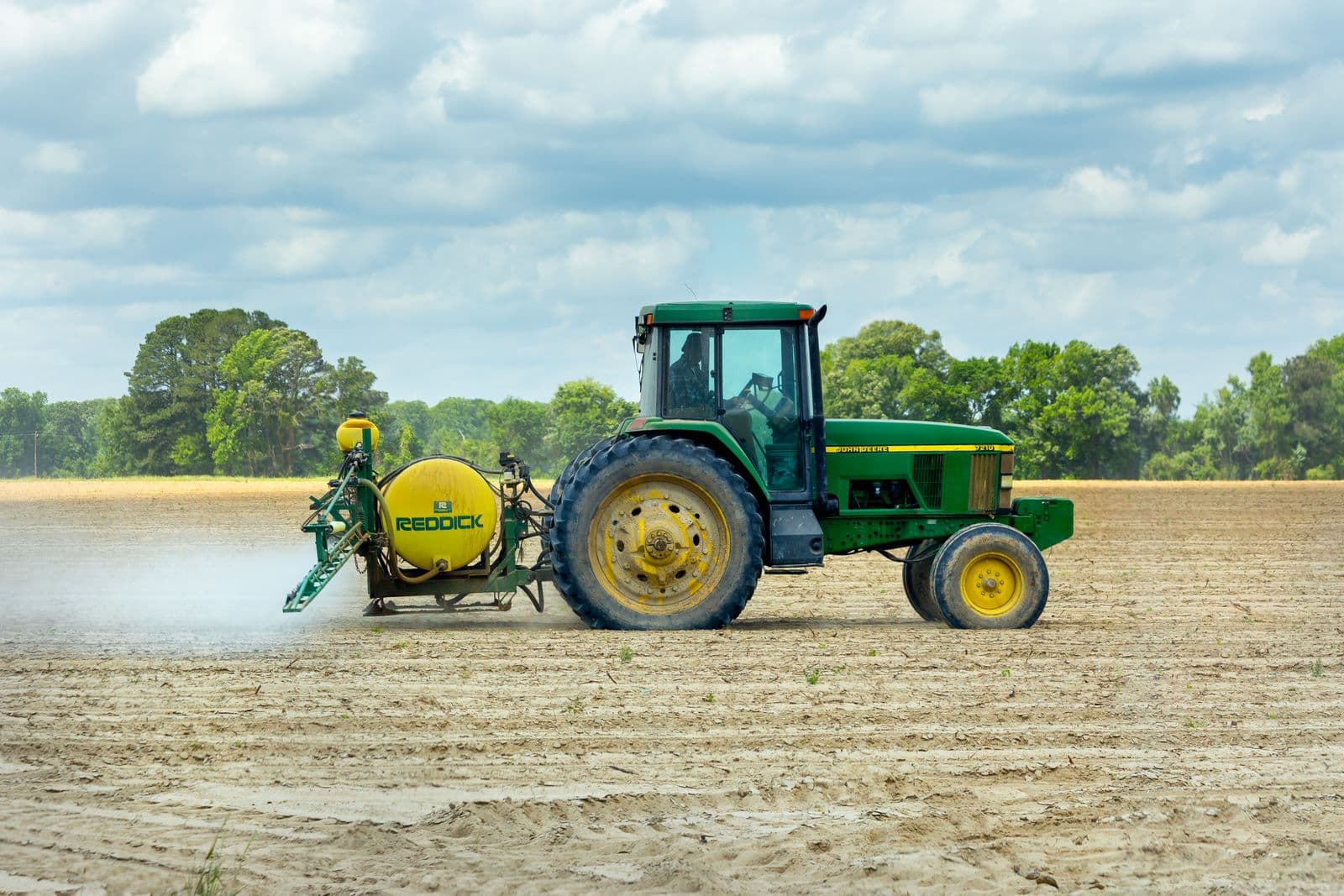
Why Spraying Needs Guidance
When you plow or disc, you can see the edge of the last pass in the soil. A sprayer leaves almost nothing behind. On a growing crop without tramlines, or on bare ground after a pre-emergence pass, the driver has to judge where the boom ended last time, and every misjudgment turns into either a strip that gets no product or a strip that gets two doses.
A double dose can scorch the crop and wastes product. A skip shows up weeks later as a stripe of weeds or disease. GPS guidance replaces the guess with a line on a screen, spaced exactly one boom width from the last.
What Overlap Costs When Spraying
Worked example: 300 acres sprayed with a product costing $15 per acre. If 10% of each pass overlaps the last one, 30 acres get sprayed twice: 30 x $15 = $450 of product wasted on one application. Four applications in a season is $1,800. Cutting the overlap to 5% saves half of that.
Plug in your own field size and rate with the spray rate calculator, and see how to reduce overlap for the other causes, such as headland turns and irregular field shapes.
GPS Options for Sprayers
| Option | Cost | Accuracy | Fits |
|---|---|---|---|
| Phone guidance app | From $30/year | 3-5 m | Wide booms on open fields, small and mid-size farms |
| Standalone lightbar | $1,500-5,000 | 30 cm - 1 m (SBAS) | Regular spraying where you want a dedicated screen |
| RTK autosteer | $5,000-25,000+ | 1-2 cm | Row crops, band spraying, large acreage, controlled traffic |
Accuracy matters less than it sounds for broadcast spraying. With a 90 ft boom, a 3 m (10 ft) error is about a tenth of the width, and what counts is that each pass sits one boom width from the last. For band spraying, narrow booms or row crops, centimeter-level RTK is the right tool. The tractor GPS cost breakdown has real kit prices.
Setting Up GPS Guidance for a Sprayer
- Set the effective spray width. Use the width the boom actually covers, not the frame length. Setting it slightly narrower leaves a small planned overlap instead of a skip.
- Spray the headlands first. Going round the edge first gives you room to turn, and the passes in the middle then start and stop on sprayed ground.
- Start the first line along the longest straight edge. Long, straight passes mean fewer turns and fewer chances to drift.
- Hold a steady speed. The rate per acre depends on ground speed as much as on nozzle output; a speed readout helps.
- Mount the screen where you can see it without turning. A lightbar works because you glance at it, not because you stare at it.
Spraying With FieldMate
Choose the Spraying operation and set your boom width (1 to 30 m). Set an A+ point and FieldMate draws parallel guidance lines one boom width apart. The lightbar shows how far off-line you are, with haptic alerts when you drift, and the Apple Watch gives steering cues on your wrist. The sprayed area fills in on the map as you drive, so gaps are visible before you leave the field, and every job is saved and can be exported as a GPX file.
$29.99/year after a 3-day free trial. It does not control boom sections or steer the tractor.
Try FieldMate FreeFrequently Asked Questions
Do I need GPS to spray a field?
No, but without it you are guessing where the last pass ended. Foam markers and fixed points help, yet on a crop with no tramlines or bare soil after a pre-emergence pass there is little to aim at. GPS guidance shows the next pass on a screen so the spacing stays even.
Is phone GPS accurate enough for spraying?
Phone GPS is accurate to about 3-5 meters. That works for keeping passes evenly spaced with a wide boom on open fields, where an error of a meter or two is a small share of the boom. For narrow booms, row crops or band spraying, you need RTK guidance with centimeter accuracy.
What width should I set for a sprayer?
Set the guidance spacing to the effective spray width of the boom, not the length of the frame. Some operators set it slightly narrower to leave a small overlap instead of risking skips, especially in wind.
How much does GPS for a sprayer cost?
A phone app costs from about $30 a year. A standalone lightbar runs $1,500-5,000, and RTK autosteer $5,000-25,000 or more, plus a correction subscription. See the tractor GPS cost page for a full breakdown.
Can GPS turn boom sections on and off?
Automatic section control needs a sprayer controller connected to a GPS display, usually part of a hardware system. A phone guidance app like FieldMate shows where you have already sprayed, but it does not switch boom sections.
